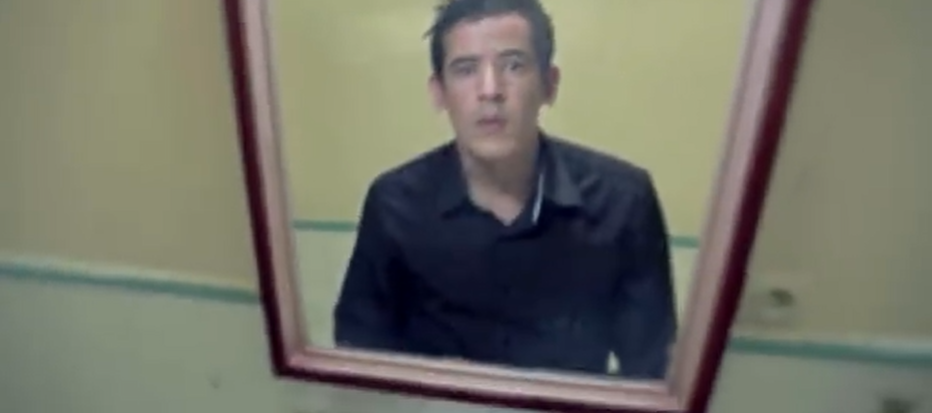
Director Khalid Douache is somewhat of an outlier in Moroccan cinema. His 2015 short film, Le proje-T, follows an evening, night, and morning in the life of Reda Benmoumen, a Moroccan ‘nobody’ who spends most of his time watching satellite television and smoking cannabis. The film’s opening sequence is blurred and shot from a slightly canted angle, intimating a disturbance in Reda’s daily routine. Tonight, something is off. Reda, played by actor Hatim de H-Kayne, splashes his face as the shot is overlaid with an amplified, racing heartbeat—he is, to use the colloquial term, ‘hitting white’ (in French: ‘faire un blanc’ or ‘faire un bad trip’; in English: ‘to whitey’).
The scene cuts quickly to Reda sitting on a sofa, where he makes a phone call to his partner saved in his phone as ‘Baby’. The film proceeds with extreme close-ups of an ashtray where Reda tips the ash from a conical, loosely wrapped ‘joint’ (or ‘cannabis cigarette’). Reda is framed in a variety of shots. These medium, close-up and extreme close-up shots become more intense and detailed as he flicks through the channels, mirroring his racing thoughts and heightening paranoia. The television broadcasts—English-language programmes and French-language news—are superimposed over shots of Reda, who seems to be zoned out yet overwhelmed by the choice presented to him.
The narrative switches rapidly between shots, matching the ‘click’ of the remote control, and displaying the word ‘Trust’ featured on a US dollar bill. Luxury cars, a herd of migrating gnu (wildebeest), crash test dummies, and lions are also visible. The documentary’s narrator says of the lions: “It is unlikely that you can see them, but they can see you.” The introduction of the English-speaking narrator and the French-language broadcast is interspersed with Reda’s Darija-language dialogue, firmly cementing the importance of sound in Douache’s narrative.
The tone of the film quickly shifts once Reda is finished watching television. Complemented by Moroccan artist DJ Key’s discography, the film’s pace quickly picks up as the narrative reaches its exposition: Reda’s kidnapping. An exterior shot of the protagonist’s home is shown in darkness whilst a group of nameless and faceless men clad in balaclavas storm the building, removing Reda from his home against his will. He is dazed, confused, and significantly, stoned. He is unaware of his situation and transported to an undisclosed location. DJ Key’s animated soundtrack intensifies the visual presentation of Reda’s capture: for the protagonist, the saxophones are getting louder and louder. He does not know why he has been taken, nor where he is going.
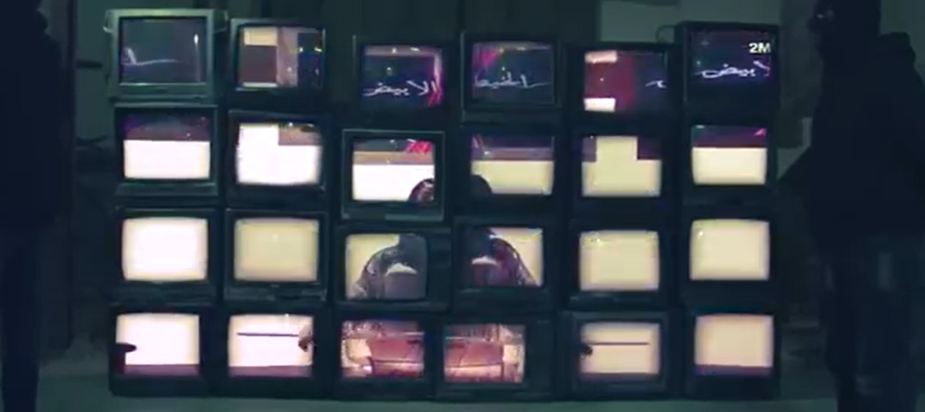
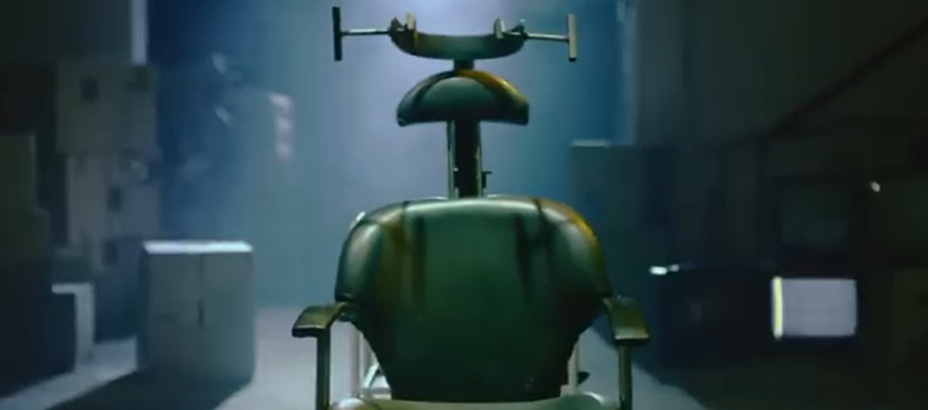
Cutting to an establishing shot of the site of Reda’s torture, displayed is the interior of a warehouse where twelve cathode-ray tube televisions (CRT televisions; ‘fat-back TVs’) are stacked in a six-wide, six-high formation. In a nod to American director Stanley Kubrick’s classic film, A Clockwork Orange (1971),a dentist’s chair is also pictured, to which Reda is strapped. His head is secured in place with bolts that squeak piercingly as they tighten, and his eyelids are taped open lightly with scotch tape. He has no choice but to watch what is being shown on the screens in front of him. Yet, unlike Kubrick’s Alex (Malcolm McDowell), Reda is not exposed to aversion therapy (or the ‘Ludovico technique’). Kubrick’s protagonist is forced to watch graphic movies and propagandist documentaries to rid him of his dangerous, harmful and violent behaviours towards other people. Le proje-T’s Reda, on the other hand, is counter-conditioned. His watching habits—generally broadcasts in French and in English—are perceived with the same level of disdain as A Clockwork Orange’s Alex’s ‘sociopathic’ behaviours. He is conditioned to watch national film and television.
Punished for his penchant for nature documentaries, and French and US television, Reda is presented as the personification of the many growing threats to Morocco’s national TV and cinema industry: low cinema attendance, rising ticket prices, and an oversaturation of foreign-produced films in the Moroccan market. He is strapped to a chair and bolted in place as an alarm sounds piercingly, and the TVs are illuminated one by one, accompanied by the crackling of static. Pictured on each screen is its own Darija-language broadcast: a Moroccan soap, drama series, or film. Reda challenges his captors and retorts: “I don’t watch these programmes… You’re gonna make me sick…” The film begins to close with a rhetorical question that exemplifies its demonstrated yet ‘perceived’ harm to Moroccan national TV and film: “Why does the Moroccan artist have no value in this country?”
The final scene cuts to Reda lying in bed. He is asleep. He startles awake, believing he has had a nightmare before he finds the balaclava of one of the masked men in the living room of his home.
Khalid Douache’s Le proje-T (2015) presents a deeply textured and overwhelming mediascape to transform a ‘whitey’ into a grander, more profound analysis of Morocco’s crisis of cinema. Blending sensory overload and multilingual layering, Douache provides a stylised counter-narrative to Kubrick’s A Clockwork Orange and characterises his protagonist as a victim of the rising tension building within Morocco’s cinema industry. During a time when Darija-language productions are increasingly dubbed into Syrian and more ‘familiar’ or ‘intelligible’ dialects, Reda symbolises the Moroccan cinema industry’s targeting of its own audiences. Moroccan audiences have, in Le proje-T, abandoned their national TV and cinema and heavily saturated Moroccan mediascapes with foreign-language productions whose viewings soar far above the viewing rates of any Moroccan production.
Ultimately, Douache’s film bends typical conventions of Moroccan cinema by forcing his audience to confront the true-to-life precarity of the Moroccan artist in an increasingly globalised world as well as the cultural value of Darija-language film and television. Le proje-T is, briefly, a film that speaks to the rapidly evolving state of Moroccan cinema. The film, ultimately, poses an important question: if not Reda, then who will be the custodian of Moroccan TV and cinema?
Leave a Reply