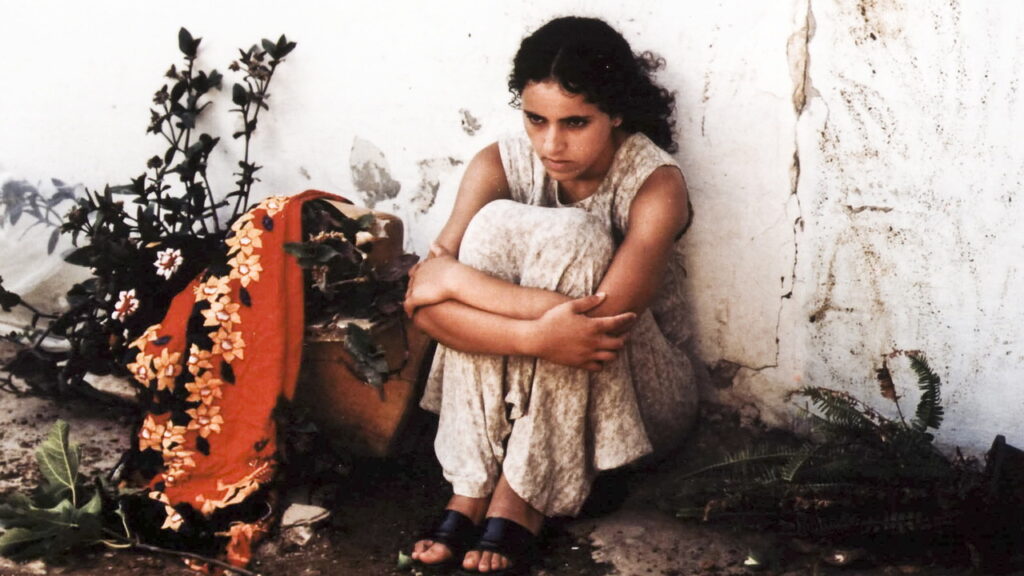
Set between Algiers and an undisclosed, nearby village, Yamina Bachir-Chouikh’s 2002 film follows its eponymous protagonist, Rachida (Ibtissem Djouadi). To date, it is Djouadi’s only feature-length film in a lead role. At the outset of the narrative, Rachida is on her way to her job at a local school when she is ambushed by a group of former students and asked to plant a bomb at the school. She refuses and is shot by a student she knows by name: Sofiane (Zaki Boulenafed). Rachida is transported by an unnamed man into the back of a van. She is taken to the hospital, where doctors treat her for a gunshot wound to the abdomen. Fraught with worry for the safety of her daughter, Aïcha (Rachida’s mother, played by Bahia Rachedi) decides that she will move with her daughter to a village. This move occurs in the hope that what Rachida and Aïcha witnessed in Algiers would not follow them to their nameless village. Rachida leaves behind her friends, family, and her fiancé, of whom she has recurring nightmares in which her loved ones experience the same pains as her.
Back in Algiers, Rachida is deemed fit to work again after a health and fitness check at the hospital. She takes a position as a primary teacher in a local school and learns that pupils at the village school and their families have already learnt about the ‘new young teacher from Algiers’. The children’s faces are bright and filled with questions for their new class leader. When asked to describe life in Algiers, the ‘white city’, she responds that it is no longer white, commonly associated with ideas of ‘purity’, but black. The city is in mourning for those left behind and those who have died. Rachida, the film, takes place during the Algerian Civil War (1992-2002), a 10-year-long struggle between armed militias and the government that saw 150,000 people lose their lives, regardless of their level of involvement during what has otherwise been referred to as Algeria’s décennie noire (‘black decade’).
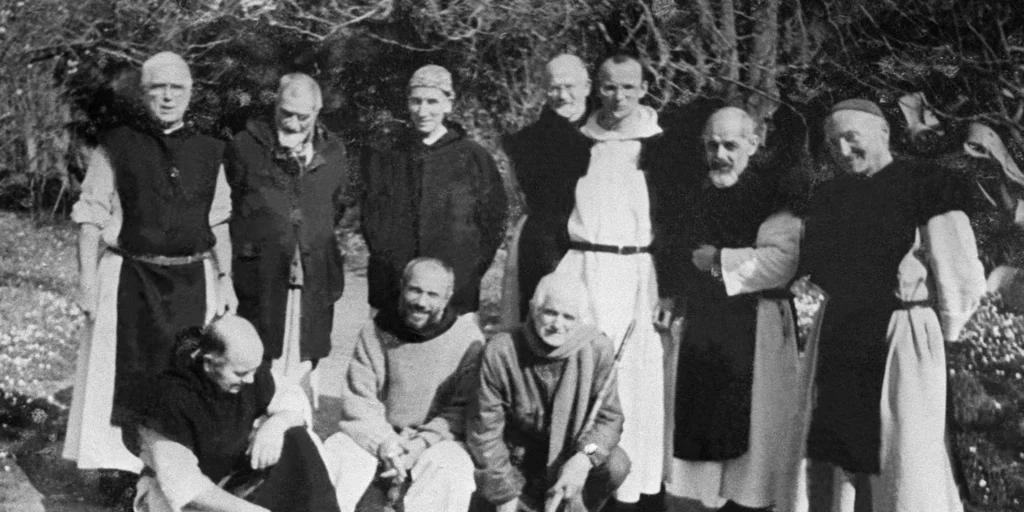
Notably, the film directly calls attention to the murder of the Tibhirine Christian monks, who were kidnapped in 1996 by the Armed Islamic Group (Groupe islamique armée; GIA) and held captive for two months before they were found dead in May of the same year. The GIA was one of the conflict’s two main belligerents. Having claimed responsibility for the death of the Tibhirine monks, GIA belligerents were also the cause of the 1993 assassination of Algerian novelist Tahar Djaout, Kabyle singer and poet Lounès Matoub (in 1998), the bombing of public transport systems in Paris and Lyon in 1995, and the Hidroelektra workers massacre in 1996, where twelve Croatian workers were murdered following a demand that non-Muslim foreigners must leave Algeria before 30 November 1993. Nearing the end of their contract to build a major dam and pipeline in Algeria, the men had less than a week before they were supposed to leave Algeria for good. They died just days before their flight was due to depart.
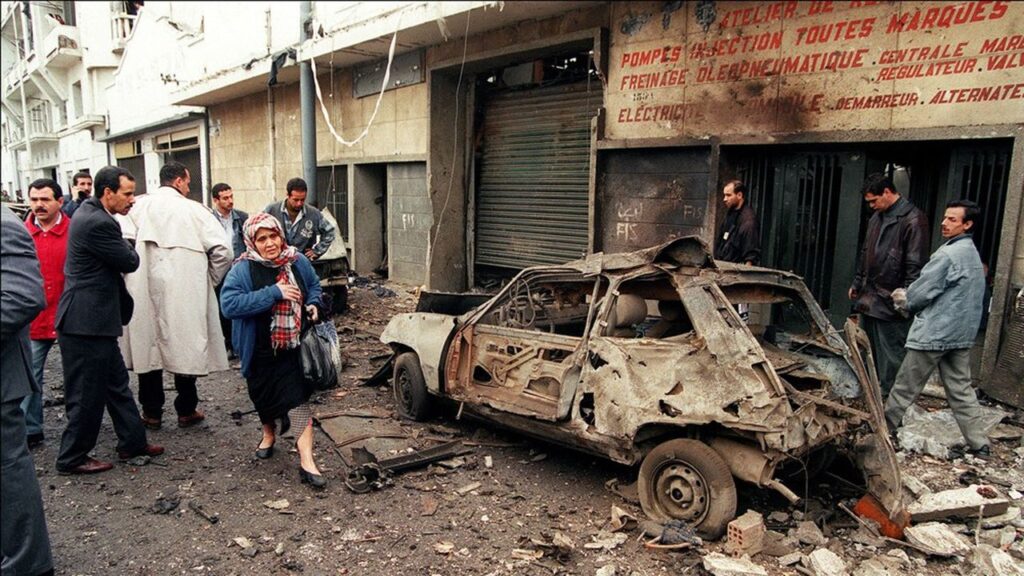
It is images of assassination, war, and bloodied violence that haunt Rachida as she moves from Algiers to the village. And slowly, her memories of life in Algiers begin to catch up with her, finally matching her pace at the village. In the village’s central square, Rachida regularly encounters men, masquerading as both citizens and terrorists, who cause havoc and serious harm in the village. Fathers are harassed by gun-wielding men for their daughter’s hand in marriage, and threatened with death if they do not comply, choosing the safety and well-being of their family rather than feeding into divisive, misinformed and political propaganda that was quietly ushered in during former President Houari Boumédiène’s move for ‘Arab socialism’ in the late 1970s.
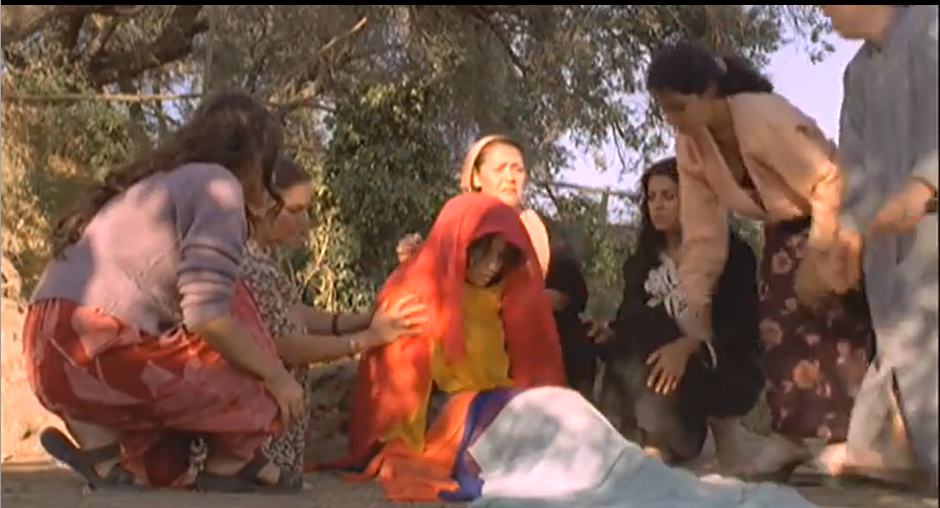
The most crucial point of Rachida’s narrative, however, is not the drastic wounding of the protagonist during the opening minutes of the film. Instead, at the film’s mid-point, the audience views a woman in the middle of a dense forest. She is running for her life and is covered in blood and bruises. It is revealed that she has been kidnapped by terrorists, presumably of the GIA, and repeatedly abused and tortured for the duration of her captivity. Upon her return to the village, she knocks on every possible door for help, to no response. She becomes despondent and collapses onto the floor in the middle of the town square, where the men of the village offer their help. She is in too much shock and appears to be afraid of the men. Clearly in a vulnerable state, the unnamed woman is not depicted in hijab, as is the custom in her home village. The women in the square, including Rachida’s mother, Aïcha, offer their own veils, and in a display of selflessness, choose to preserve the woman’s modesty over their own, as it is clear in this moment that normative ideas of gendered attire in early 2000s Algeria must move aside for the protection of a young woman in need of support. Yet, perhaps true to differing social attitudes between men and women during the Algerian Civil War, the unnamed woman is disowned by her father as ‘impure’.
Shortly after the woman’s return to the village, she attends a wedding with Rachida and Aïcha, when the event is stormed by armed men. The sound of gunshots drowns out the screams of the men, women, and children whose lives were lost, and the cries of their families. Taking cover in the curb-side brush, Rachida finds a baby lying on the street, whom she scoops up and cares for until the next day, where she is pictured rocking in place, seemingly not having moved since the previous night. She is visibly distressed and stuck in place until she learns the fate of Aïcha, her mother. Lightly injured and pictured with a bandage to her head, Aïcha survives, and Rachida begins to self-regulate her nervous system anew.
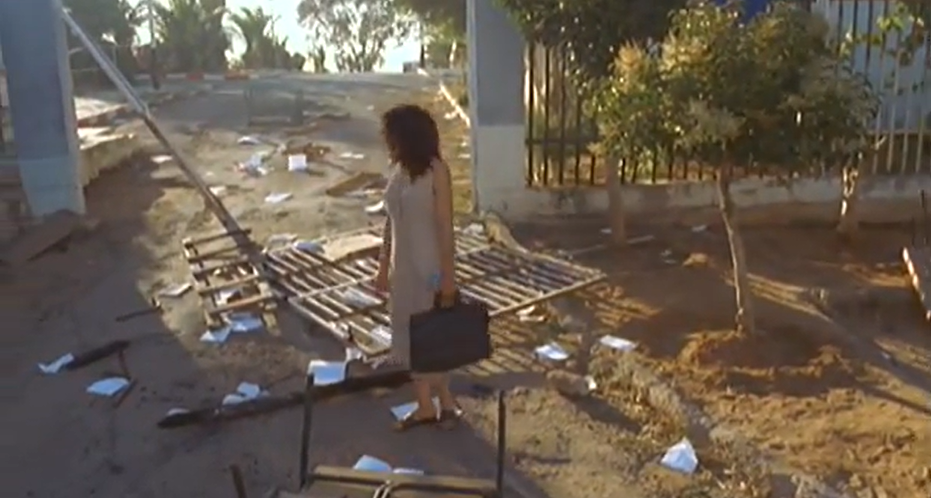
Rachida returns to the village school where she is still employed as a teacher. She arrives at the entrance where the gates have been blown off their hinges, and she must navigate rubble and debris to enter her workplace. She almost gives up and seems reluctant to believe anyone will arrive for her lessons. Slowly, however, her class began to show up for their daily lessons one by one. The camera cuts sharply from an establishing shot of the building’s exterior façade to the interior of Rachida’s classroom. Her classroom is not full, and students ask her about the whereabouts of their classmates who had died in the previous night’s massacre. Rachida does not respond. Instead writes, in Arabic, on the blackboard: ‘Today’s lesson’.
Leaving the viewer with the lingering question of what lessons can be learned during conditions of civil war, Bachir-Chouikh’s Rachida is more than an astute portrayal of the Algerian Civil War. Drawing together themes of resistance, trauma, terror, patriarchy, and exile during the décennie noire, the film exposes both the open wounds and the bridges that lead directly to healing. Bachir-Chouikh’s narrative forces a direct confrontation with the brutal realities of the Algerian Civil War, and rather than focusing on the physical embodiment of the pains of conflict, Rachida is a film that demonstrates that the comfort of closure is not always guaranteed. It is a feeling, to be clear, that remains and cannot be explained away easily without the necessary unpacking of the psychological damage interspersed between the human damages of war.
Leave a Reply