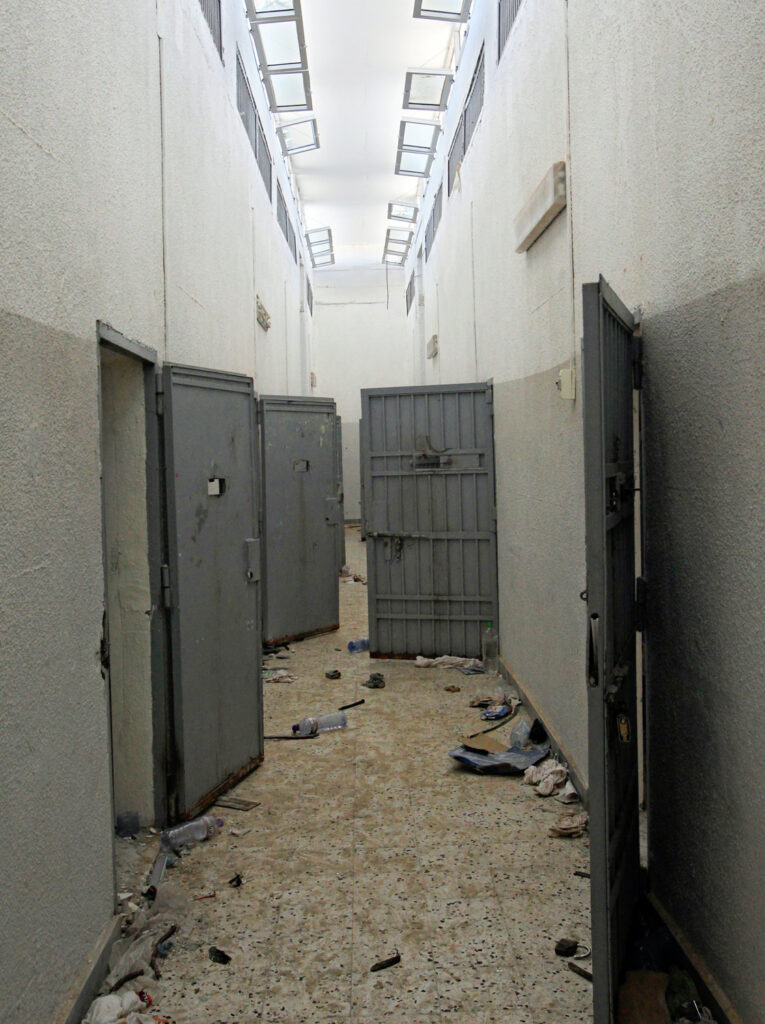
In 1996, more than 1,200 inmates at Abu Salim Prison were rounded up in its courtyard in the Libyan capital, Tripoli, and shot dead by firing squad. Pressured by organisations such as Human Rights Watch and Amnesty International, Libyan authorities appointed a seven-judge panel to complete an investigation into the killings. The report remains unpublished despite being due for delivery to the UN in 2010. The HRW further notes the ‘unresolved disappearances’ of various members of the Libyan opposition, such as Jaballa Hamed Matar and Izzat al-Megaryef (in 1990), as well as the disappearance of Lebanese Shia Imam, Musa Al-Sadr, whose case is yet to be closed. Al-Sadr has now been missing since 1978, and his disappearance is continuously invoked in discussions of contemporary post-2011 Libyan politics and the fall-out of the Gaddafi regime in the country’s major urban centres: Tripoli, Benghazi, Misrata, and Zawiya.
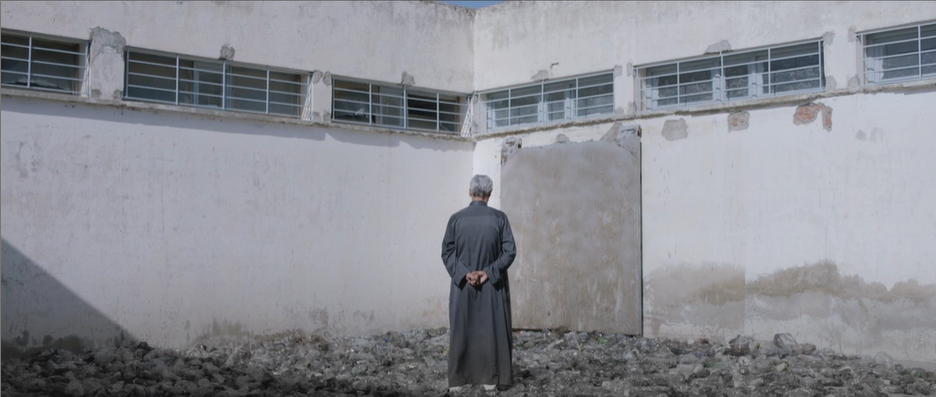
Muhannad Lamin’s 2019 film, The Prisoner and the Jailer, brings together two contrasting characters: the old and weary Haj (Eissa Abdulhafeez) and Sheikh (Ali Elshol), whose memories of the Abu Salim Prison massacre drive the film’s main narrative. To be clear, Lamin’s 15-minute short film follows Sheikh as he reckons with the carceral politics of post-Gaddafi Libya. Beginning with an establishing shot of the prison courtyard at Abu Salim Prison, Sheikh is presented with his back to the camera, depicted wearing a thawb as he stares up at the courtyard’s walls, marked with bullet-holes from the massacre that took place 20 years before the release of Lamin’s court métrage.
The camera cuts abruptly to an interior shot of the warden’s office, where a large Libyan flag is draped across the entirety of the office’s back wall. It is the newly readopted national flag of Libya, replacing Gaddafi’s verdant, plain yet rich green. Sheikh sits in a medium shot against a backdrop of red, black, and green, symbolising regime change and visibly demonstrating that the film takes place following the ousting of Libya’s former President, Muammar Gaddafi (1977-2011). Sheikh, the warden, is accompanied on either side by prison guards, dressed in the grey camouflage uniform of Tripoli’s militia-controlled prisons. For Sheikh’s tenure as warden of Abu Salim, his modes of power and control in his role as a senior prison official are not marked by the brutalities of Gaddafi’s indiscriminate imprisonment policies, but informed by an acute awareness that Libya has been liberated, and positive social change can begin to occur both within Libya’s prisons and in the public sphere.

Yet, Sheikh’s capacity to run his prison efficiently is stifled, in this 15-minute film, by the presence of one prisoner in particular: Haj, an older gentleman of few words. He is presented throughout as haggard, tired, and unkempt. With overlayed shots of Sheikh leading the prison guards in their daily prayers, the sound of Haj being beaten by younger guards is audible from the room where Sheikh leads his junior colleagues in performing Takbeer and Sana, leading into Surah Al-Fatiha. Shortly thereafter, Haj and Sheikh renew their dialogue in the warden’s office, joined again by prison guards in similar tactical or combative attire. This scene displays Haj’s first spoken contribution. Addressing Sheikh, Haj responds angrily to his previous violent treatment by the guards. He spits the words: “You threaten me, you beat me…” before a song begins to play on the junior prison guard’s mobile phone. Its lyrics are heard as the camera pans between the film’s two protagonists, intimating at the historical relationship between the two protagonists: “We are lifetime companions… what’s between us is known.”
Prompting a critical shift in the narrative by indirectly revealing a shared past, the film quickly spirals into a flashback, presented from Sheikh’s perspective and revealing his prior associations with Libya’s complex prison sector, controlled both by the government and outsourced to militia-controlled areas in Tripoli, Benghazi, and elsewhere. The treatment of people who are imprisoned varies between institutions, though it is necessary to note that Amnesty International, a UK-based human rights charity, has repeatedly decried the repeated abuses experienced by refugees and asylum seekers in the country’s detention centres and prisons. The change of perspective demonstrated in The Prisoner and the Jailer reveals to the audience that as a younger man, Sheikh was previously imprisoned for a ‘cover-up’ that is not fully explained during his own dialogue with his former prison warden.
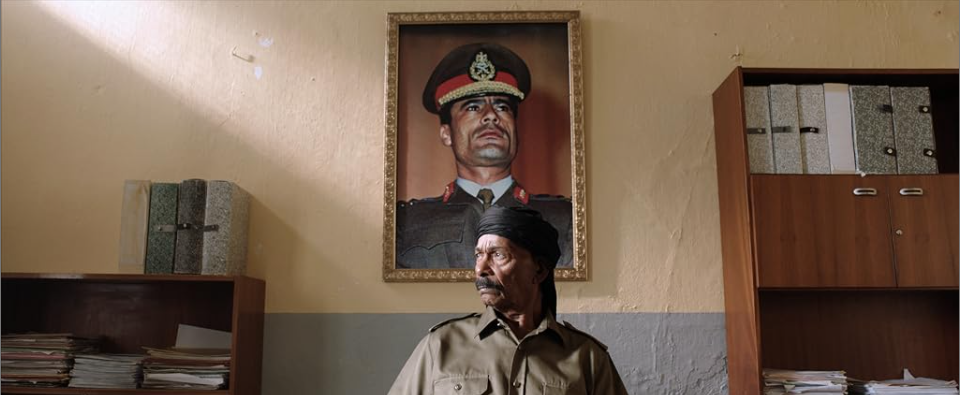
The flashback cuts to reveal Sheikh, with a darker beard and more youthful expression, sitting in a chair facing the warden’s desk. A large-scale framed photograph of Gaddafi in military attire with a stern, downward gaze that meets each viewer at eye level. The framed presence of Gaddafi dominates the scene’s atmosphere and inserts the regime as an ever-present participant in daily interactions. Haj, the exhausted, haggard, and unkempt inmate of the film’s present-day is pictured in direct contrast to the worn and desperate Sheikh. Haj towers over the prison warden’s desk, presented in the green formal attire of Gaddafi’s decades-long regime. He is clean-shaven and speaks with a demanding tone of voice, wearing an arrogant expression throughout his conversation with Sheikh.
Menacingly, Haj offers a chilling yet ironic retort to the wrongfully imprisoned Sheikh: “Human rights are for prisoners of conscience.” Sheikh is perceived as unworthy of his basic rights merely because he has been targeted as an opponent of Gaddafi’s 40-year stronghold on Libyan culture, politics, and society. Perhaps as his own narrative jab at authoritarianism in pre-Arab Spring Libya, director Lamin uses direct quotes from firsthand testimonies of people formerly imprisoned in Libya’s various formal and informal spaces of confinement. The narrative jumps quickly back to the present-day, in post-revolutionary Libya, where Sheikh poses his own question to Haj, his former captor: “Do you remember the last time we met in Abu Salim?” The scene fades from the interior of the warden’s office and returns to the location of the film’s opening sequence: the internal courtyard of Abu Salim Prison. Dozens of men are pictured being corralled into the relatively small concrete area. The sound of bullets hitting metal is interspersed with the cries and shouts of the 1,270 men whose lives were lost in the massacre of 1996. The film closes with several guards positioned on the roof, guns in hand. They operate, seemingly, on shoot-to-kill orders. The inmates are their targets.
The Prisoner and the Jailer (2019) is a rare example in the relatively limited catalogue of Libyan cinema available to view today. An undiscovered jewel in post-2011 Libyan cinema, the film stands as a testament and affirmation of the many scars of seeing and knowing the world in the wake of regime-style politics. It provides a vital benchmark for a cinema that is dramatically underexplored and misrepresented on the global stage.
Leave a Reply